

Extra lens implant
Nearsightedness, farsightedness and astigmatism can be corrected by inserting an extra lens in front of your natural lens. With this procedure, you can see clearly again without glasses or contact lenses.
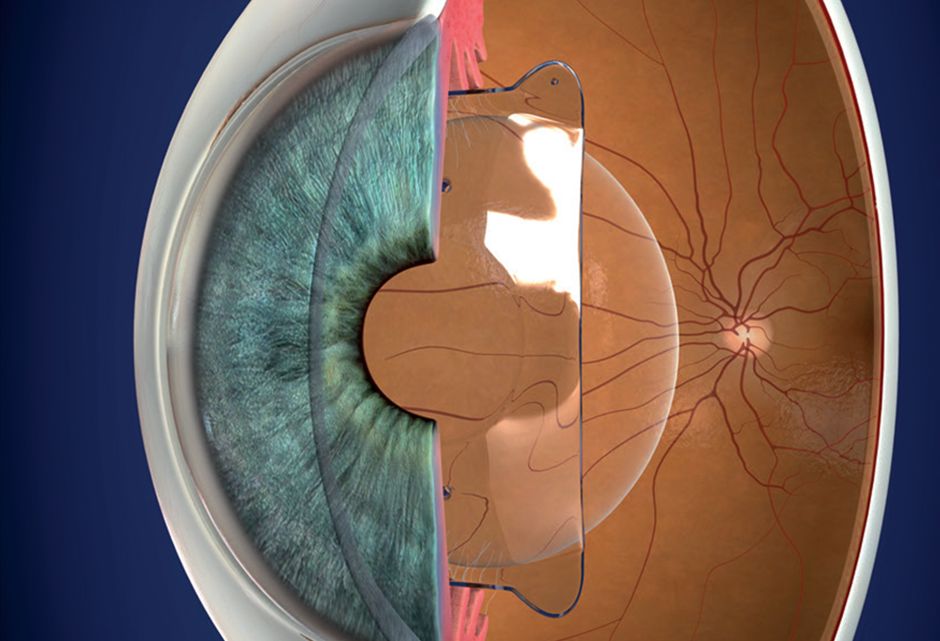
In this procedure, we implant an extra lens in your eye, without treating or removing your own lens. The new lens is either placed over the iris (Claw or Phake lens) or behind the iris (Implantable Contact Lens (ICL)). Both techniques can be used to correct astigmatism. The extra lenses are not visible to you or anyone else and are very well tolerated.
When are you eligible for an extra lens implant?
- Vision specifications
High myopia (from -8 to -22 dioptres), farsightedness (from +4 to +12 dioptres) and/or astigmatism (from 0.5 to 6.0 dioptres) can be corrected with an extra lens implant.
The implant of a (toric) iris claw lens or a (toric) ICL offers an effective and safe alternative for patients who are not eligible for laser treatment, for example if the correction needed is too high or if the cornea is too thin or irregular.
- Age
- Recent intake examination
The intake exam used as the basis for your treatment must not have been carried out more than six months before the actual procedure.
We’re happy to help!
Your vision, your comfort, your happiness: this is what we care about at Brussels Eye Doctors. Our experienced team is ready to help you and answer all your questions.
Start your process towards a life without glasses today, and schedule an extensive pre-operative exam and an initial conversation to get to know you (+/- 2 hours), so that together we can determine the best solution for you.
- After your intake exam, the lenses will be custom-made for your eyes. When your eyes have a cylindrical divergence, we will opt for a toric lens.
- A few days before the procedure, you will need to apply some preparatory eye drops at home.
- When you arrive at our centre, we start with a few administrative tasks. Next, you will get some eye drops in order to dilate or constrict your pupil. This takes around 30 minutes. You can relax.
- Once your pupils are sufficiently dilated or constricted, we will accompany you to the operating room. There, your eyes will be anaesthetised with drops and carefully disinfected.
- While you lie back comfortably, we will insert the artificial lens via a small incision in your eye. After inserting the artificial lens in the right position, it will automatically take on the right shape.
- The procedure takes fifteen minutes per eye and is nearly painless.
The price of an extra lens implant varies, depending on various individual factors. We consider it important to make a personal price calculation for each patient. For an overview of our fees, please go to the fees page.
Frequently Asked Questions
What are lens implants and how does a lens implant work?
A lens implant, also known as an ICL (Implantable Collamer Lens), is an additional lens that is placed between the iris and your natural eye lens. Your own natural lens remains completely intact and in place. Through a tiny 2.2 mm incision, the folded lens is inserted into the eye, where it automatically unfolds into its final position. The flexible material is highly biocompatible, meaning the body does not reject it.
Can a lens implant be used for dry eyes and what is the minimum age for lens implantation?
Yes. When laser eye surgery is not recommended, for example because of dry eyes or a cornea that is too thin, a lens implant can be an excellent alternative. Your natural eye lens remains fully preserved. The minimum age for this procedure is 18 years.
Is it better to choose laser eye surgery or a lens implant?
That depends on the characteristics of your eyes. Lens implantation is typically considered when laser eye surgery is not suitable, such as in cases of thin corneas or dry eyes. The main advantage of an ICL is that your natural eye lens remains untouched. The most suitable treatment option is determined during a comprehensive pre-operative examination that takes approximately two hours.
How much does lens implantation cost and is the procedure painful?
The procedure is completely painless and takes about ten minutes per eye under local anaesthetic eye drops. No needles are involved. Any enhancement treatment required within the first year is covered under the treatment guarantee. Health insurance funds and hospitalization insurance policies may partially or fully reimburse the procedure.
What should you avoid after lens implantation and what is the recovery process like?
One day after the procedure, your visual acuity is typically already restored to around 80%. Reading, watching television, and performing light activities can usually be resumed immediately. For at least three weeks, you should avoid rubbing your eyes, wearing eye make-up, and lifting heavy objects. Swimming and sauna visits should also be avoided during this period. Contact sports should be postponed for a full month.