
Reduction of vision
Deteriorating vision is something that affects many people. Your near or far vision can get worse and/or images can appear slightly distorted. We will determine the cause and the appropriate treatment for you.
Common forms of vision impairment include:
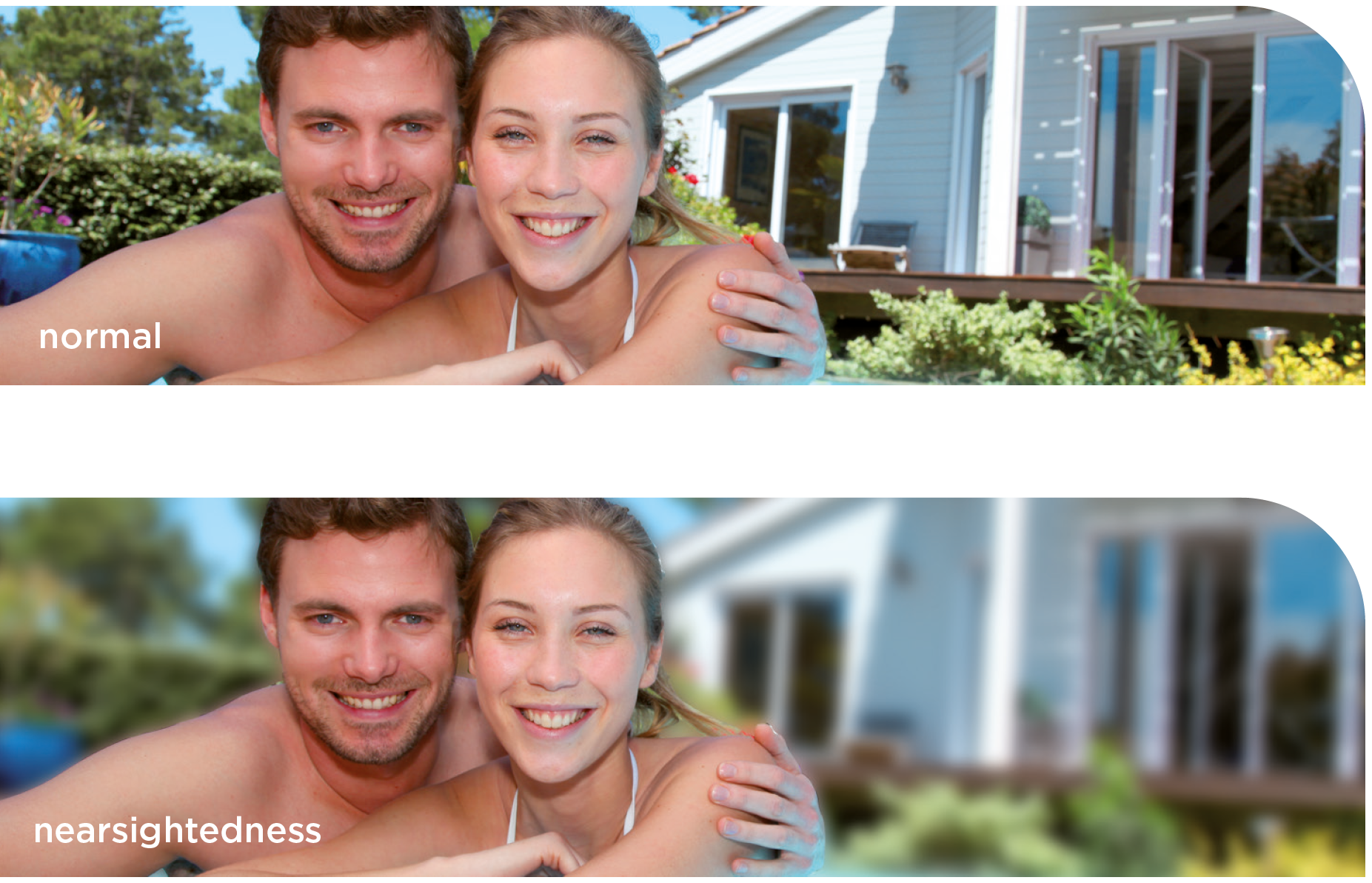
- Nearsightedness - You see objects that are nearby clearly, but distant objects are blurred.
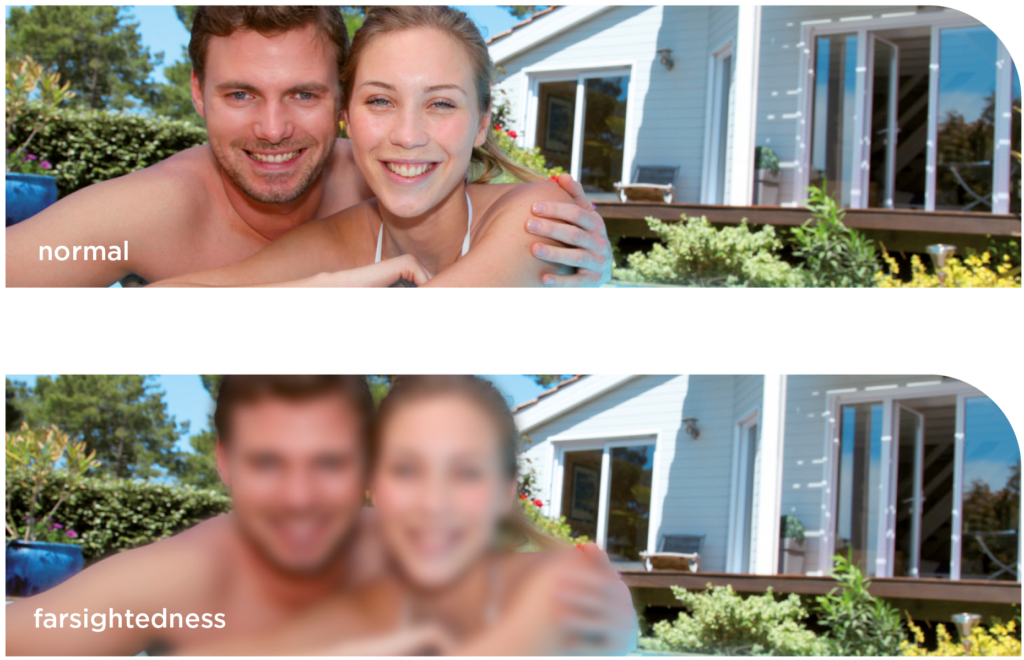
- Farsightedness - You see distant objects better than objects nearby.
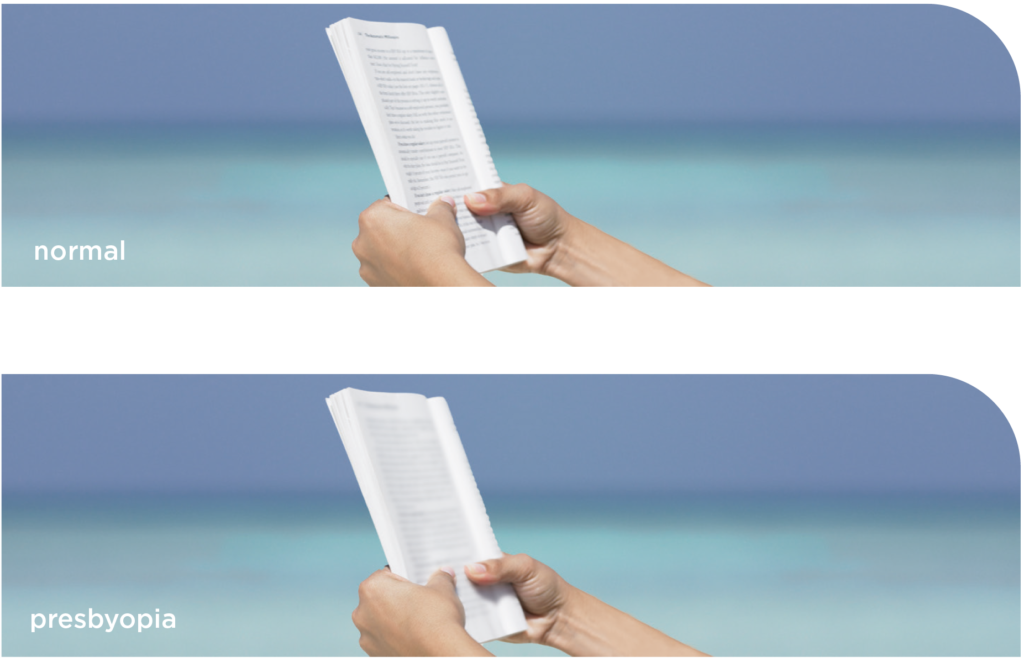
- Presbyopia - From the age of 45, reading becomes more difficult, because the lens of your eye loses some of its flexibility.
- Cylindrical divergence or astigmatism - Distortion of the image.
Nearsightedness
- What is nearsightedness?
Nearsightedness or myopia is the condition whereby you see near objects clearly, but everything at a distance appears blurred. This is caused by a refractive error in the eye. Normally, the refraction of the cornea and the lens ensure that you have a sharp image of objects at a distance on your retina. If the shape of your eye is too long or the curve of your lens is too steep, you won’t get a sharp image of objects at a distance on your retina. People with nearsightedness need a correction with a minus power.
Nearsightedness is mostly a hereditary condition. If one of the parents has this condition, there is a higher chance that the child will also have myopia. Environmental factors also play an important role in the emergence and evolution of nearsightedness.
A person who needs a prescription of -6 dioptres or more is said to have high myopia.
Nearsightedness generally develops between the ages of 6 and 12. It gradually increases as the eye grows and the length of the eye increases. Once a child has reached adulthood, the condition generally stabilizes. Nearsightedness in children is a growing problem worldwide. As a result of heavy use of screens (mobile phones tablet, computer, …), nearsightedness in children has increased significantly in recent years.
Apart from the necessity of wearing glasses, excessive elongation of the eye is a risk factor for many other eye diseases.
• Slowing nearsightedness in children
Nearsightedness in children can be slowed down by:
- limiting work up close (reading / tablet / smartphone / crafts)
- looking more often into the distance
- and spending as much time as possible outside in daylight
A good rule of thumb here is the so-called 20-20-2 rule:
-
- After 20 minutes of steady work with objects up close (reading / tablet / smartphone / crafts),
- At least 20 seconds looking into the distance.
- At least 2 hours a day should be spent outside in the daylight.
In addition, you can insist that your child reads at a distance of at least 30 cm.
Treatment of nearsightedness in children
In addition to preventing nearsightedness in children, you can also treat it.
A first step is the use of corrective lenses, whereby the eyes are supported with glasses of an appropriate prescription.
As a second step, atropine drops can be administered. The atropine will dilate the pupil and relax the eye’s ciliary muscle. Administer one drop in each eye of your child every day before going to sleep.
High myopia (-6 dioptres or more) may cause the retina to thin, since the eye stretches more and more. After the age of 40, this can give rise to other problems, such as vitreous or retinal detachment or macular degeneration. In case of high myopia, there is also a greater chance of developing cataracts or glaucoma.
- Treatment of nearsightedness
Your ophtalmologist can prescribe the appropriate glasses or contact lenses in order to correct the divergence of your vision.
As an adult, you can also opt to get rid of your glasses or contacts. At our eye centre, we offer different treatments available for this purpose, such as laser treatments, an extra lens implantation or a lens replacement. Together, we determine the most suitable treatment for you depending on the condition of your eyes, your own preferences and your life and work situation.
Farsightedness
- What is farsightedness?
Farsightedness or hypermetropia is the condition whereby your eyes can see distant objects clearly, but things close up appear blurred. Depending on the degree of farsightedness, you will not be able to see things at a distance without correction either. This is caused by a refractive error in the eye. Normally, the refraction of the cornea and the lens ensure that you have a sharp image of objects nearby on your retina. If the shape of your eye is too short, you won’t get a sharp image on your retina of objects close up, and sometimes even at a distance. Both reading and distance vision therefore become more difficult. People with farsightedness need a correction with a plus power.
- Treatment of farsightedness
You can opt to support your eyes with corrective glasses or contact lenses of the appropriate prescription.
As an adult, you can also opt to get rid of your glasses or contacts. At our eye centre, we offer different treatments available for this purpose, such as laser treatments, an extra lens implantation or a lens replacement. Together, we determine the most suitable treatment for you depending on the condition of your eyes, your own preferences and your life and work situation.
Presbyopia
- What is presbyopia?
Presbyopia is the condition whereby the elasticity and ability of your ocular lens to focus decreases. Therefore, you have more difficulty seeing nearby objects clearly. This arises after the age of 45 and affects everyone. Both people who don’t wear glasses and those with nearsightedness or farsightedness will develop presbyopia around the age of 45.
- Treatment of presbyopia
You can opt for the use of corrective glasses, which means the eyes are supported with (reading) glasses. If you already wear glasses or contact lenses for distance vision, a reading segment will be added to your distance glasses or contacts.
You can also opt to get rid of your glasses or contacts. At our eye centre, we offer different treatments available for this purpose, such as an extra lens implantation or a lens replacement. Together, we determine the most suitable treatment for you depending on the condition of your eyes, your own preferences and your life and work situation.
Astigmatism or imperfect curvature of the cornea or lens
- What is astigmatism?
Astigmatism means that your eye is not perfectly round. For good visual acuity, the cornea should have the same shape (curvature) in all directions (like a football). If you have astigmatism, then your cornea is steeper in one direction than the other (like a rugby ball). This causes images to appear stretched. For example, a dot is seen as a line. If you have astigmatism, you can see less clearly both from a distance and nearby. Astigmatism often occurs in combination with nearsightedness or farsightedness.
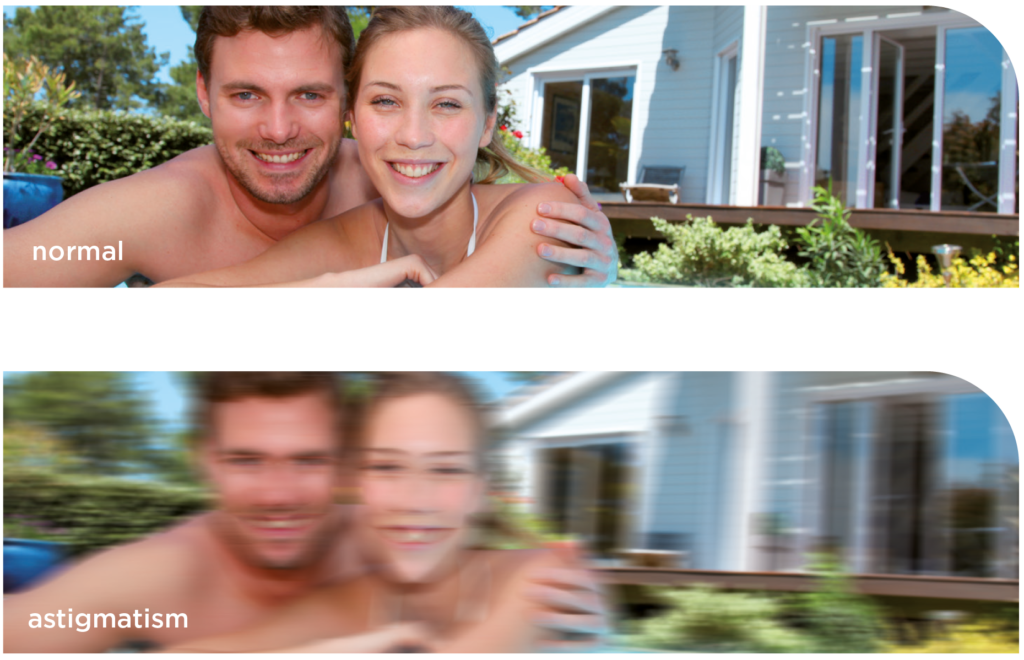
- The treatment of astigmatism
You can opt for the use of corrective lenses, whereby the eyes are supported with glasses of an appropriate prescription. A cylinder can be added to glasses or contact lenses.
As an adult, you can also opt to get rid of your glasses or contacts. At our eye centre, we offer different treatments available for this purpose, such as laser treatments, an extra lens implantation or a lens replacement. Together, we determine the most suitable treatment for you depending on the condition of your eyes, your own preferences and your life and work situation.
Frequently Asked Questions
Can you be both nearsighted and farsighted at the same time?
No, this is not possible. However, it is common for existing nearsightedness (myopia) to occur alongside presbyopia, an age-related difficulty with near vision that typically develops from the age of 45 onwards. At Brussels Eye Doctors in Brussels, we can correct multiple refractive errors in a single procedure, for example through Laser Blended Vision or lens replacement surgery.
How does a person with astigmatism see the world?
People with astigmatism experience distorted vision both at distance and up close. The cornea is shaped more like a rugby ball than a football, causing images to appear stretched, blurred, or distorted. Astigmatism often occurs together with myopia or hyperopia (farsightedness).
Can astigmatism be corrected with laser eye surgery?
Yes, astigmatism of up to 6 diopters can be treated with laser eye surgery. Brussels Eye Doctors offers several laser techniques, including LASIK and PRK. The procedure takes a maximum of 10 minutes per eye, is completely painless, and can be performed from the age of 18.
Can nearsightedness or farsightedness be permanently corrected without glasses?
Yes, both refractive errors can be permanently corrected so that you are no longer dependent on glasses. At Brussels Eye Doctors, you can choose between laser eye surgery (for myopia up to -8 diopters and hyperopia up to +4 diopters) or an implantable collamer lens (ICL), which preserves your natural eye lens. The most suitable option for your eyes is determined during a comprehensive pre-operative examination lasting approximately two hours.
What happens during the pre-operative examination for laser eye surgery at Brussels Eye Doctors?
The pre-operative examination at Brussels Eye Doctors takes just over two hours. During this assessment, we measure your visual acuity, eye pressure, tear film quality, corneal thickness, and the structures of your eyes. Soft contact lenses should be removed three days before the examination, while rigid contact lenses should not be worn for three weeks beforehand. The results remain valid for six months and allow the ophthalmologist to recommend the most appropriate treatment for your specific situation.